


China Speed: when faster decisions become a competitive advantage

For years, executives have used the term China Speed to describe the country's ability to innovate, industrialize, launch products, and adapt at remarkable pace. The phrase has become a familiar part of boardroom discussions, strategy reviews, and investor conversations around the world.
Yet speed alone does not explain what makes some companies successful in China.
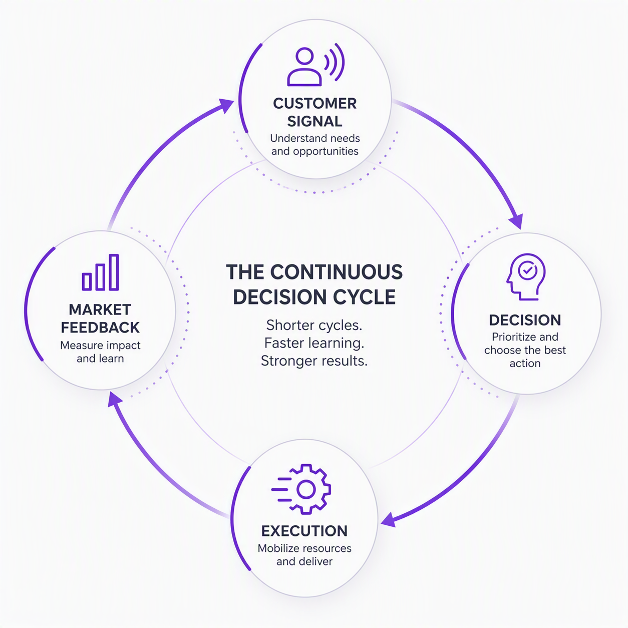
After hundreds of discussions with multinational executives through IMA Asia[1]'s research and member dialogues, one observation appears repeatedly: the companies that perform best in China are not simply faster at execution. They are better at reducing the time between market signals, decisions, and action.
They reduce the time between a market signal and a response.
As business cycles accelerate, technologies evolve more quickly, and customer expectations continue to shift. That capability is becoming a significant source of competitive advantage.
China as a competitive testing ground
For many multinational leaders, China is more than just another market. It is often an early view of competitive dynamics that eventually emerge elsewhere.
Product cycles are shorter. Customer expectations evolve faster. Competitive intensity is relentless.
In that environment, organizational weaknesses rarely remain hidden for long.
What may be manageable in a relatively stable market quickly becomes visible when a competitor can launch threeproduct iterations while a decision is still moving through internal approval processes.
The examples are numerous. Chinese EV manufacturers have dramatically reduced vehicle development timelines.Pharmaceutical companies continue to accelerate drug development cycles.Consumer brands test and refine products at a pace that forces global competitors to rethink how they innovate. Digital platforms routinely deploy customer-facing solutions in weeks rather than months.
Across industries, the same pattern emerges. Companies that react faster to market developments tend to outperform those held back by internal delays.
In many multinational companies, the primary constraint is not a lack of capital, talent, or strategy. It is difficult to convert market developments into decisions and decisions into action.
The hidden cost of delay
Organizational delay rarely appears on a balance sheet. Yet its cost can be substantial.
As companies grow, they add reporting layers, control mechanisms, governance structures, compliance requirements, and approval processes. Each is introduced for legitimate reasons. Collectively,they create friction.
Promising initiatives become trapped in approval cycles.
Supply-chain opportunities disappear before sourcing decisions are made.
Local teams identify market shifts but struggle to mobilize the company quickly enough to respond.
High-performing managers become frustrated when obtaining approval requires more effort than solving the problem itself.
When decisions are delayed, the learning that comes from them is delayed as well.
In fast-moving markets, learning is cumulative. Every experiment, adjustment, and decision generates information.Companies that move through those cycles faster gradually build an advantage that becomes increasingly difficult to replicate.
Why do some companies move faster than others?
Several characteristics appear repeatedlyin executive discussions.
The first is proximity to the market.
In highly responsive companies, information reaches decision makers quickly. Insights from customers and frontline teams do not stop at every layer of management before action can be taken.
The second is the closeness between customers, suppliers, industrial partners, logistics providers, and technology players. When these actors interact continuously, coordination costs naturally fall.
The third is the distribution of decision-making authority. Some companies continue to centralize most decisions. Others allow more decisions to be made closer to customers and market realities.
In highly contested markets, companies simply do not have the luxury of waiting.
Speed stops being a management preference and becomes a market requirement.
A playbook for shortening decision cycles
Multinational companies cannot replicate China's ecosystem. Nor should they try.
What they can do is identify where time is lost inside their own companies. In many cases, the issue is not access to information. It is the time required to turn information into decisions and decisions into action.
Reduce the number of layers between the market and decisionmakers
In many companies, market signals travel through reporting lines, presentations, dashboards, and committees before reaching out to someone who can act.
Each individual step appears reasonable.Together, they can add weeks of delay.
The issue is rarely the amount of information available. It is the time required for that information to reach a person with the authority to decide.
Leadership question: How many people sit between an important customer signal and the person who can act on it?
Close the gap between accountability and authority
Many local teams are accountable for results but lack the authority to respond quickly.
They identify market shifts, competitive threats, and commercial opportunities, while key decisions remain concentrated at headquarters.
This model may function adequately instable environments. It becomes much harder to sustain when markets move quickly.
Discussions within IMA Asia suggest that the challenge is often not decision quality, but decision speed.
Leadership question: Which decisions could be made locally without materially increasing risk?
Reassess critical approval processes
Few multinational companies today sufferfrom a lack of governance.
Many, however, have accumulated approval layers over time that add delay without meaningfully improving outcomes.
Some controls genuinely improve decision quality. Others simply extend timelines.
In highly competitive markets, a few additional weeks can be enough to eliminate an advantage.
Leadership question: Which approval steps would materially change the final decision if they were removed?
Make procurement a source of speed
Procurement functions are often measured on cost reduction and risk management.
Yet in many industries, access to the right supplier at the right moment is a competitive advantage.
Strategic suppliers, manufacturing capacity, and technology partners do not remain available indefinitely.
A delayed decision can sometimes be more costly than an imperfect negotiation.
Leadership question: How much time passes between identifying a strategic supplier and putting that supplier into operation?
Measure the time between a business request and delivery
Many companies are trying to move faster while their internal systems continue to operate at a different pace.
For business teams, the relevant metric is not the number of digital projects launched or the size of technology budgets.
It is the time required to turn a business requirement into a usable solution.
Meanwhile, the market continues to move.
Leadership question: How long does it take to convert a business decision into operational capability?
Identify human bottlenecks
The most significant delays are not always process-related.
A critical position remains vacant for months. A single expert must approve every high-risk decision. Too many decisions converge on one executive. A local team lacks experience of acting independently.
These bottlenecks rarely appear on management's dashboards, yet they often explain a significant share of execution delays.
Leadership question: Which individuals or functions have become decision bottlenecks in your company?
Align resource allocation with market speed
Opportunities do not wait for the next annual planning cycle.
The most responsive companies are often not those that invest more. They are those that can redirect resources quickly when opportunities or risks emerge.
The objective is not to weaken financial discipline. It is to ensure budgeting processes do not become a source of strategic delay.
Leadership question: How long does it take to fund an initiative that has already been identified as a priority?
Measuring what slows the company down
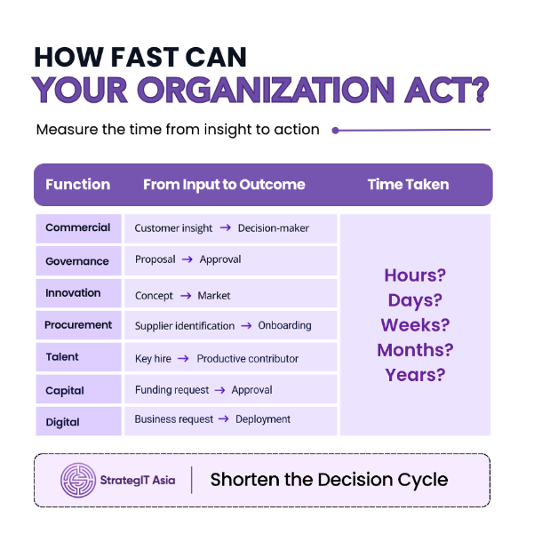
Most executive teams rigorously track financial performance. Far fewer measure time.
How many days have passed between a meaningful customer signal and a management decision?
How long does it take to approve an investment?
To onboard a new supplier?
To launch a new product?
To hire a critical role?
To deploy a digital capability requested by the business?
These indicators often reveal more about a company's ability to adapt than many traditional financial metrics.
Looking ahead
The lesson China offers multinational leaders today is not that every company should operate like a Chinese company.
China itself will continue to evolve. Demographic shifts, geopolitical tensions, technological change, and workforce expectations will reshape competitive dynamics over time.
But China's experience already highlights areality that many companies are beginning to recognize access to information has become easier than ever. The ability to act quickly on that information remains far rarer.
Access to information is no longer the differentiator it once was.
What increasingly matters is how quickly a company can turn information into decisions, and decisions into action.
That may be one of the most important lessons China offers multinational leaders today.
In many industries, competitive advantage depends less on what a company knows than on how quickly it acts.
[1] IMA Asia is a long-establishedexecutive forum network that brings together senior multinational leadersacross Asia-Pacific to exchange practical insights on strategy, markets andbusiness performance. The observations referenced in this article draw ondiscussions among executives operating on the front lines of Asia's mostdynamic markets.